
Criminal Cases in the Greene County Courts
Greene County Criminal Court hears felony prosecutions in Tennessee's Third Judicial District. General Sessions Court handles misdemeanors, warrants, first appearances, bond matters, and preliminary felony hearings. A felony can therefore produce entries in both courts before indictment or bind-over moves it to Criminal Court. The Greene County Circuit Court Clerk serves both courts, as well as Circuit and Juvenile Courts, from Suite 302 of the county courthouse.
Municipal Court has a narrower role. It deals with Greeneville city citations and matters within municipal authority, not felony trials. Schedule information is available through Greeneville Police Department Records. A person unsure of the correct court should start with the county clerk and describe the event, charge type, and date. That avoids treating a city citation, General Sessions file, and Criminal Court judgment as though they were the same Greene County court record.
Greene County Four-Court Records Hub
Clerk Whitney Shelton Collins's office is the local hub for four courts. The county's official description confirms its role in Criminal, General Sessions, Circuit, and Juvenile matters. That structure matters because the title "Circuit Court Clerk" does not mean the office holds only civil Circuit Court papers.
The official county clerk page below shows the office readers must contact for a Greene County criminal case record.
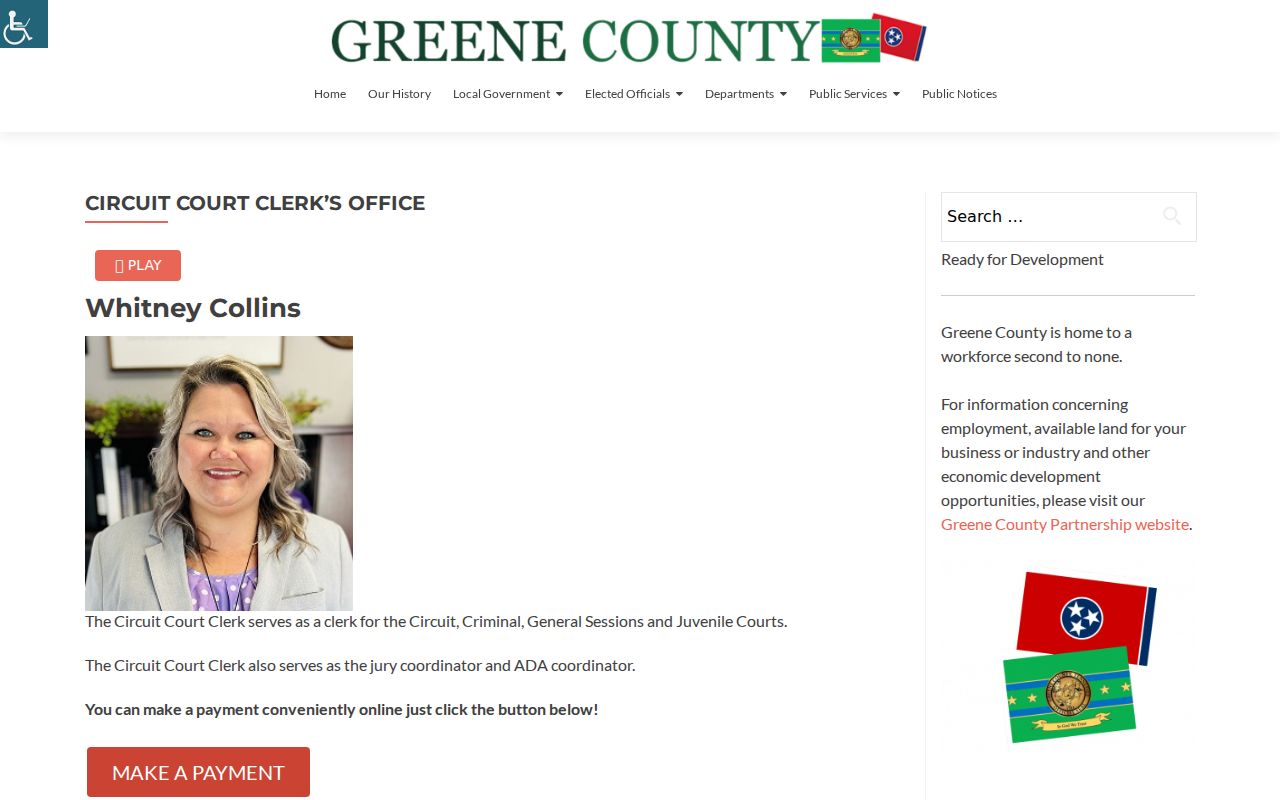
Use the office name, court division, and case number together when ordering a docket sheet or certified judgment. The courthouse counter is at 101 South Main Street, Suite 302, Greeneville, and is open Monday through Friday from 8:00 a.m. to 4:30 p.m. Its main published number is 423-798-1760, with 423-798-1762 and 423-798-1765 also listed. Fax requests go to 423-798-1763.
How to Search Case Records
Tennessee does not offer one public statewide trial-court docket portal, and Greene County's online payment link is not a documented case-search database. The reliable route is the Circuit Court Clerk by counter, phone, or fax. Start with a case number when possible. If none is known, give the full name and a useful date range, then ask the clerk to check both General Sessions and Criminal Court when a felony may have moved between them.
- Classify the matter as a city citation, misdemeanor, or possible felony.
- Give the clerk the case number, or the full name and date range if it is unknown.
- Ask for both General Sessions and Criminal Court when the path is unclear.
- Request the docket sheet and final disposition or judgment before selecting more pleadings.
- Confirm copy and certification costs, plus archive retrieval time, before ordering.
The table lists search details supported by Greene County research. It is a clerk-request inventory, not a claim that a public web form exists.
| Field Label | Type | Required | Notes |
|---|---|---|---|
| Case number | Identifier | No | Best way to isolate the correct file |
| Full name | Text | Yes, without case number | Use the complete known spelling |
| Date range | Date | Recommended | Helps separate similar names |
| Court division | Choice | No | Ask for both courts if uncertain |
| Document requested | Text | Yes for copies | Start with docket and judgment |
Greene County Device-Free Case Visits
A courthouse visit takes advance planning. Phones, smart watches, cameras, backpacks, large handbags, weapons, vapes, outside food, and several other items are prohibited. Medication must stay in its original labeled bottle. Most important for a file request, electronic evidence must be printed or saved to an external drive before arrival. Bringing the only case number on a barred phone can halt a Greene County case search at the door.
The official Tennessee clerk profile is visible in the Greene County clerk capture.
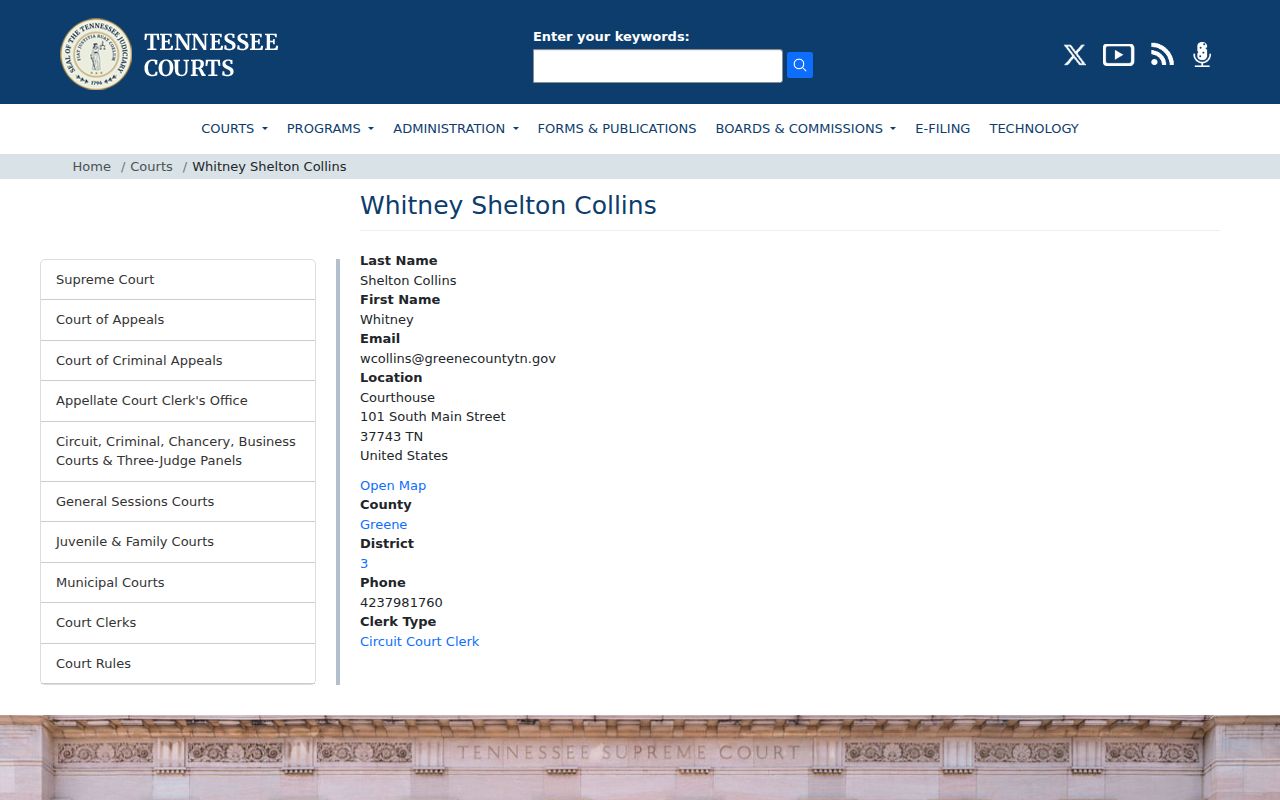
Bring printed names, dates, and file numbers. Ask Courthouse Security at 423-798-1800 extension 1536 about an item before traveling if its status is unclear. All people and property are subject to search, so the published entry rules form part of practical court-record access.
What the Case File Shows
A Greene County court file follows the prosecution, not just the arrest. The docket provides an event list, while the charging paper, plea or verdict, judgment, and sentence answer separate questions. The clerk should confirm each field in an actual file because Greene County does not publish a public sample docket. Protected personal details may be redacted.
| Case Number & Court | Identifies the file and whether it sits in General Sessions or Criminal Court. |
|---|---|
| Charging Document | States the filed allegations, statutes, and charge classes. |
| Docket Entries | Chronological filings, appearances, motions, and orders. |
| Hearing Dates | Scheduled and completed court events shown in the file. |
| Disposition & Judgment | Records the plea, verdict, dismissal, or other final result. |
| Sentence & Conditions | Shows incarceration, probation, costs, fines, and court-ordered terms when applicable. |
Bond, counsel, warrants or capiases, appeal entries, and an expungement order may also appear. A case file can contain information absent from TORIS, including motions and hearing history. For most readers, the docket and signed judgment are the best first request because they show both the route and the outcome.
Greene County Case Dispositions and TORIS
A court disposition is the result recorded by the clerk. TORIS is different. The Tennessee Bureau of Investigation builds its state criminal history from arresting-agency fingerprints, then links disposition data supplied by clerks and justice agencies. TBI reports that some submissions are rejected when identifying data is missing or cannot be tied to an arrest. A blank disposition on a rap sheet therefore does not prove that a Greene County criminal case remains open.
The Tennessee judiciary provides court directories and appellate case history, illustrated by the official judiciary image below.
When the state history and local file conflict, obtain the signed Greene County judgment first. The clerk's original case establishes what the court did. A person reviewing their own mismatched TORIS history can then use TBI's correction or fingerprint-comparison route with proof from the originating court.
Stages of a Criminal Case
A filed charge begins the court record. General Sessions may handle warrants, initial appearances, bond, and a preliminary hearing. A felony that proceeds can move to grand-jury action and Criminal Court, while a misdemeanor can remain in General Sessions. Pretrial motions and hearings build the docket before the defendant enters a plea or the matter goes to trial. The judgment then records the result and any sentence.
Case flow: Charges Filed › Arraignment › Pretrial › Plea or Trial › Disposition › Sentencing
No fixed local timeline is published in the research. Hearing dates, continuances, charging decisions, and court calendars affect each Greene County case. Read the dated docket entries instead of estimating progress from an arrest date alone.
Greene County Felonies Cross Courts
Tennessee's charge classes help explain why one felony can leave records in two Greene County courts. Class A through E felonies belong in Criminal Court for trial and judgment, but General Sessions handles early felony proceedings. Misdemeanors usually remain in General Sessions. A booking label is only the arrest allegation, and a prosecutor may amend the charge before final judgment.
The official judicial district map places Greene County with Hamblen, Hancock, and Hawkins Counties in the Third Judicial District.
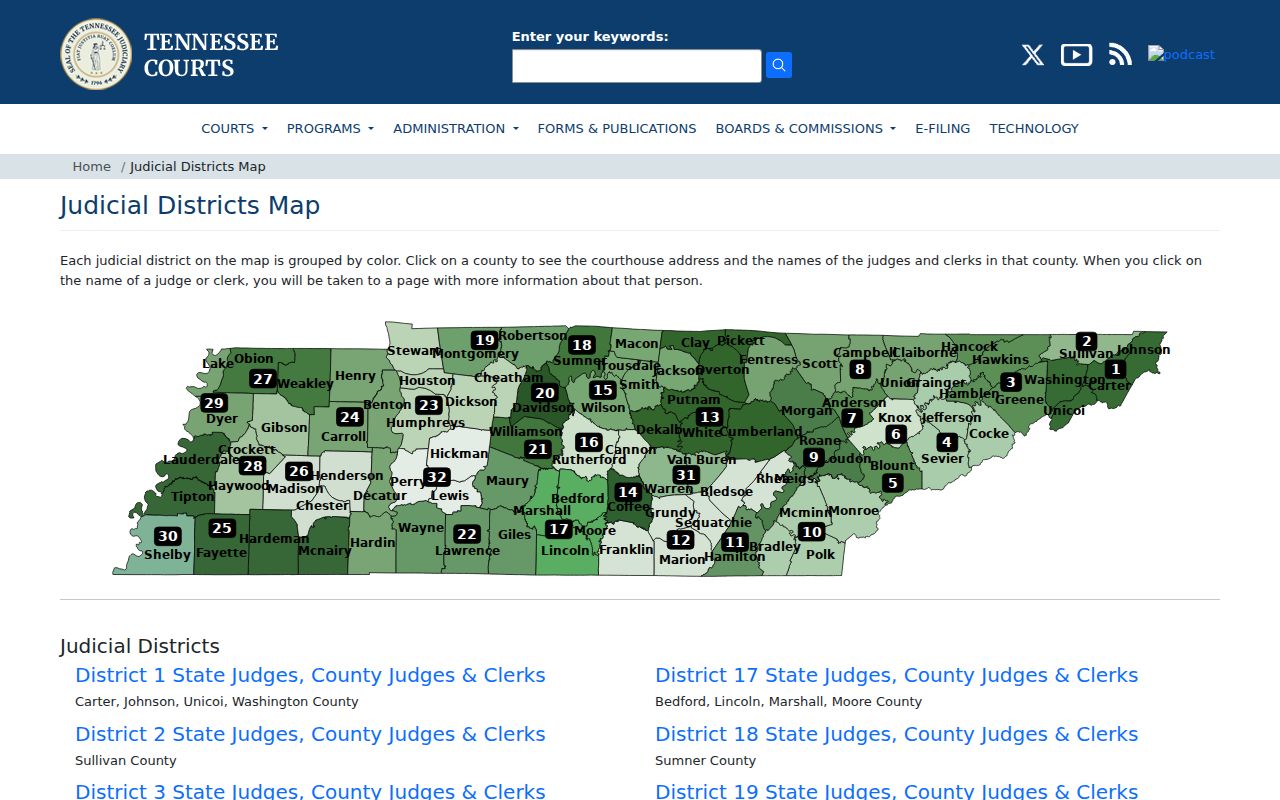
The four-county district explains shared judicial assignments, but it does not merge local case files. Greene County pleadings and judgments stay with the Greene County clerk. Ask for both local divisions when a felony's preliminary file and final Criminal Court record are both needed.
Note: The charge class shown at booking is not the final conviction class; rely on the signed Greene County judgment for the outcome.
Access & Restrictions
The Tennessee Public Records Act supplies an inspection framework, including a seven-business-day response framework under Tenn. Code Ann. §10-7-503. Access is not unlimited. Section 10-7-504 and other laws protect specified records, while §37-1-153 restricts ordinary juvenile court files. Sealing and expungement orders, victim or minor data, Social Security numbers, protected addresses, and account details can also limit what a public copy shows.
Ask for segregable public portions when a file contains both open and protected material. If the office denies access, request the statute or court order supporting that decision. Older Greene County files may be offline, so absence from an online payment screen proves nothing. Ask whether the case is archived and how long retrieval may take. Copy, search, and certification fees for criminal cases were not posted on the clerk page, so confirm the current price before ordering.
Greene County Federal Court Cases
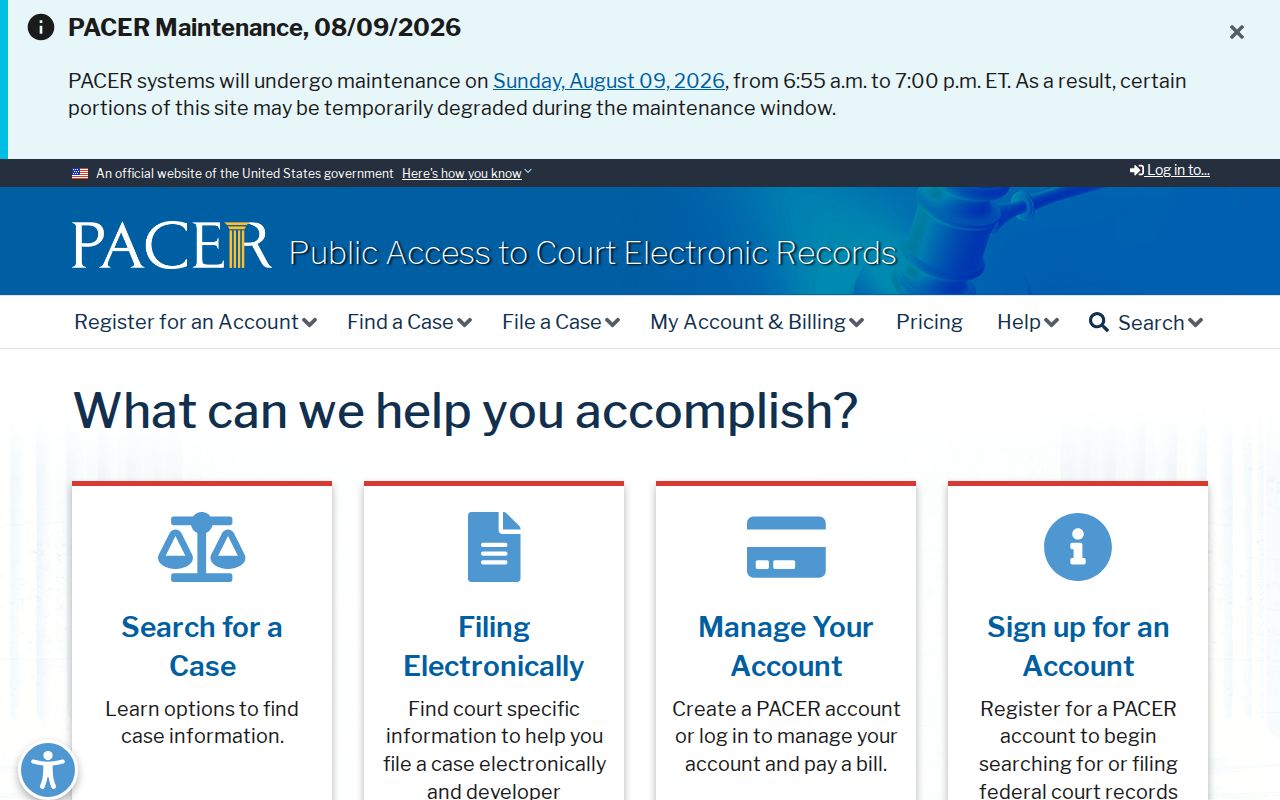
Greeneville also hosts a federal court layer. The Greeneville Division of the U.S. District Court for the Eastern District of Tennessee covers ten northeastern Tennessee counties, including Greene County. A federal matter is not filed with the county clerk. The official access route is PACER, which requires registration and supports searches by party, case number, and court.
The PACER image below shows the separate federal case-access system.
Check PACER's current fee schedule before stating or relying on a price. Sealed material, grand-jury records, and protected identifiers remain unavailable or redacted. The local U.S. Attorney office is at 220 West Depot Street, Suite 423, Greeneville, with phone 423-639-6759. That address should not be confused with the Greene County Criminal Court clerk at South Main Street.